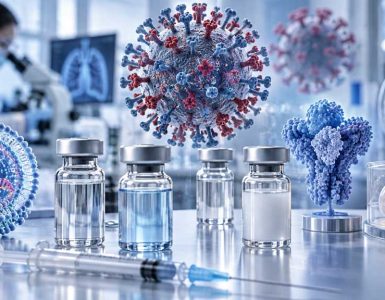

Synthetic biologists and an interdisciplinary team based at the University of Oxford recently created a bacterial superglue that researchers may be able to use to speed the development of vaccines. The bacterial superglue is comprised of two proteins, one named SpyCatcher and the other called SpyTag. When the two bacterium Streptococcus pyogenes join, they are unbreakable. By encoding SpyCatcher into virus-like particles (VLP), the proteins can be glued together. “We tested the SpyCatcher-VLP [and] SpyTag-antigen combination using a range of malarial and cancer-relevant antigens,” Karl Brune, who led the work in professor Mark Howarth’s lab in Oxford’s Department of Biochemistry, said. “This showed that linking can be done simply and quickly to produce stable vaccines that generated robust antibody responses.” Most vaccines are made of VLPs, which are similar to viruses but lack the pathogenic genetic material that causes disease, making the vaccines harmless. Scientists design the VLPs to show a specific attribute...
🔒 Premium Content - For Free
Unlock this content by becoming a Global Health Press subscriber. Join for exclusive articles, expert research, and valuable insights!