
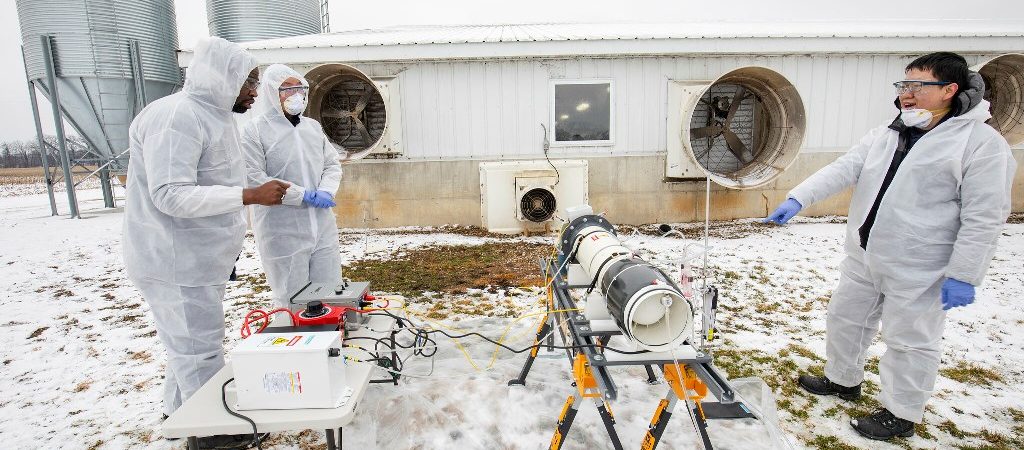
Dangerous airborne viruses are rendered harmless on-the-fly when exposed to energetic, charged fragments of air molecules, University of Michigan researchers have shown. They hope to one day harness this capability to replace a century-old device: the surgical mask. The U-M engineers have measured the virus-killing speed and effectiveness of nonthermal plasmas–the ionized, or charged, particles that form around electrical discharges such as sparks. A nonthermal plasma reactor was able to inactivate or remove from the airstream 99.9% of a test virus, with the vast majority due to inactivation. Achieving these results in a fraction of a second within a stream of air holds promise for many applications where sterile air supplies are needed. “The most difficult disease transmission route to guard against is airborne because we have relatively little to protect us when we breathe,” said Herek Clack, U-M research associate professor of civil and environmental engineering. To gauge nonthermal plasmas’ effectiveness, researchers pumped a...
🔒 Premium Content - For Free
Unlock this content by becoming a Global Health Press subscriber. Join for exclusive articles, expert research, and valuable insights!